Under-sink cabinets are awkward because their empty space is not a simple rectangle. Pipes interrupt the middle, hinges narrow the opening, and the basin hangs lower than you expect. An organizer chosen from the cabinet’s outside dimensions can easily fail to fit.
Begin by deciding what belongs there. Then work around the fixed parts of the cabinet, keeping plumbing and shutoff valves accessible. A few modest storage zones are often more useful than a complicated assembly.
Start with a safe, dry cabinet
Remove the contents and inspect the cabinet base. If you notice dampness, a persistent odor, staining, or an active drip, address the source before adding storage. A liner or bin is not a repair.
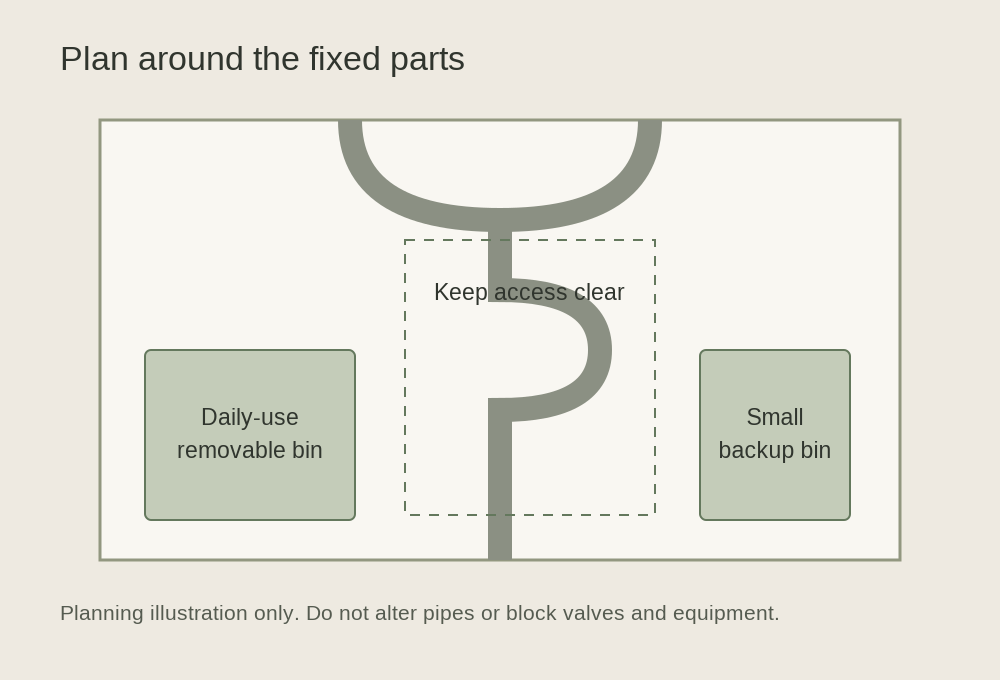
Do not loosen pipes or alter electrical connections to make an organizer fit. Keep access to valves, disposal equipment, outlets, and any other service points clear. Follow applicable installation instructions and use a qualified professional when a repair requires one.
Keep cleaning products in original labeled containers. Follow their storage directions and keep them appropriately secured away from children and pets. Do not store food under the sink.
Measure around the obstacles
Record three sets of measurements:
- The opening: width and height between hinges and doors.
- The cabinet interior: usable width, depth, and height.
- The obstacles: where pipes, valves, the basin, disposal equipment, and cables occupy space.
Use an empty cardboard box to test the footprint of a possible bin. Open and close both doors and check whether you can remove the box without hitting a pipe.
Allow for movement, not just fit
A pull-out organizer needs clearance along its full travel path. A tall bottle needs room to stand upright and to be lifted out. A handled bin needs space for your hand.
Leave a clear route to the plumbing. You should not need to dismantle a storage system to reach a shutoff valve.
Choose a few practical zones
Keep daily tools near the front
Put the supplies you use most often in a small removable caddy or shallow bin. In a kitchen, that might be dishwashing brushes and suitable daily cleaning supplies. In a bathroom, it may be a washable bin for cleaning tools.
Keep the container light enough to lift comfortably. If a caddy holds every backup bottle too, it becomes harder to carry and harder to return.
Separate backups from the working supply
Place unopened replacements in their own clearly defined area. Check that storage instructions allow the location. Under-sink cabinets can be humid, so avoid assuming paper goods, spare linens, and moisture-sensitive items belong there.
If the cabinet is cramped, move backup supplies to another suitable secured location. You do not need to make every household supply fit beneath one basin.
Give small loose items a shallow home
Loose cloths, replacement brush heads, and spare cleaning tools can disappear behind bottles. A shallow washable tray keeps a small category together without building a tall stack.
Store only clean, dry cloths. Let damp tools dry appropriately before returning them, and clean the tray when needed.
Storage ideas and their limitations
1. Removable open bins
Open bins are adaptable because you can place them around plumbing and lift them out for maintenance. Choose dimensions that pass through the cabinet opening without tilting against pipes.
Consider how spills will be cleaned. Do not combine products in a way that conflicts with their label instructions, and do not treat a bin as a substitute for secure storage.
2. A narrow pull-out organizer
A pull-out can make a deep side section easier to reach. Check the full frame width, the mounting method, and the space needed to clear the door hinge.
Some designs require screws or rails. Confirm that installation is appropriate for the cabinet and, if you rent, permitted by the lease. Do not drill without checking what is behind the surface.
3. An adjustable shelf around plumbing
A shelf with a removable middle section may use vertical space, but its advertised range is not enough to establish fit. Check the lowest point of the basin and the position of the drain trap.
The frame must be stable under its intended load. Avoid balancing shelves on bottles, pipes, or improvised supports.
4. A lightweight door-mounted holder
A small holder can work for a cloth or a lightweight item when there is clearance. Test the closed-door position before attaching it.
Check the finish, door thickness, attachment instructions, and weight limit. An over-door hook can stop a cabinet closing if its top edge is too thick.
5. A washable cabinet liner
A removable liner may make routine cleaning easier. Cut it so it lies flat and does not interfere with equipment or hide areas you need to inspect.
Lift it periodically to check underneath. A liner can conceal moisture, so it should support inspection rather than replace it.
6. Storage somewhere else
Sometimes the best under-sink idea is to store less there. Put toiletries in a suitable drawer, cleaning backups in a secure utility area, or dry towels outside a damp cabinet.
This is especially useful in a small bathroom vanity where a deep basin consumes much of the available height.
Kitchen and bathroom needs are different
In a kitchen cabinet
Prioritize access to dishwashing tools and keep food elsewhere. Do not block the dishwasher connections, disposal equipment, or shutoff valves.
If your countertop is crowded, first consider whether you have too many daily supplies open at once. The small-kitchen guide includes a simple sink-area reset.
In a bathroom vanity
Keep the daily personal-care routine separate from cleaning chemicals. Store items according to their labels; a humid cabinet may not suit medicines, electrical devices, or paper supplies.
Use a separate accessible area for the items you use every morning so cleaning supplies do not have to be moved each time.
A simple layout to test before buying
Try one small removable container on each side of the cabinet, leaving the center clear. Put frequently used items on the easier-to-reach side and a modest backup supply on the other.
Use the arrangement for several days. Notice what is difficult to reach and what repeatedly stays on the floor or counter. If you still need an organizer, you now have a precise problem and measurements to guide the choice.
Our storage category comparison can help you evaluate bins, risers, turntables, and pull-outs without relying on invented product ratings.
Keep the system easy to inspect
During ordinary cleaning, remove the bins, inspect for dampness, and wipe the cabinet as appropriate for its finish. Check containers for leaks and replace damaged ones according to their instructions.
The useful system is the one you can take apart quickly, clean easily, and return without a puzzle. If your pantry needs the same kind of reset, try the small-pantry method next.
Keep a little inspiration
Save this guide for later.
Make a note of the ideas you want to try next.
Save to Pinterest (opens in a new tab)